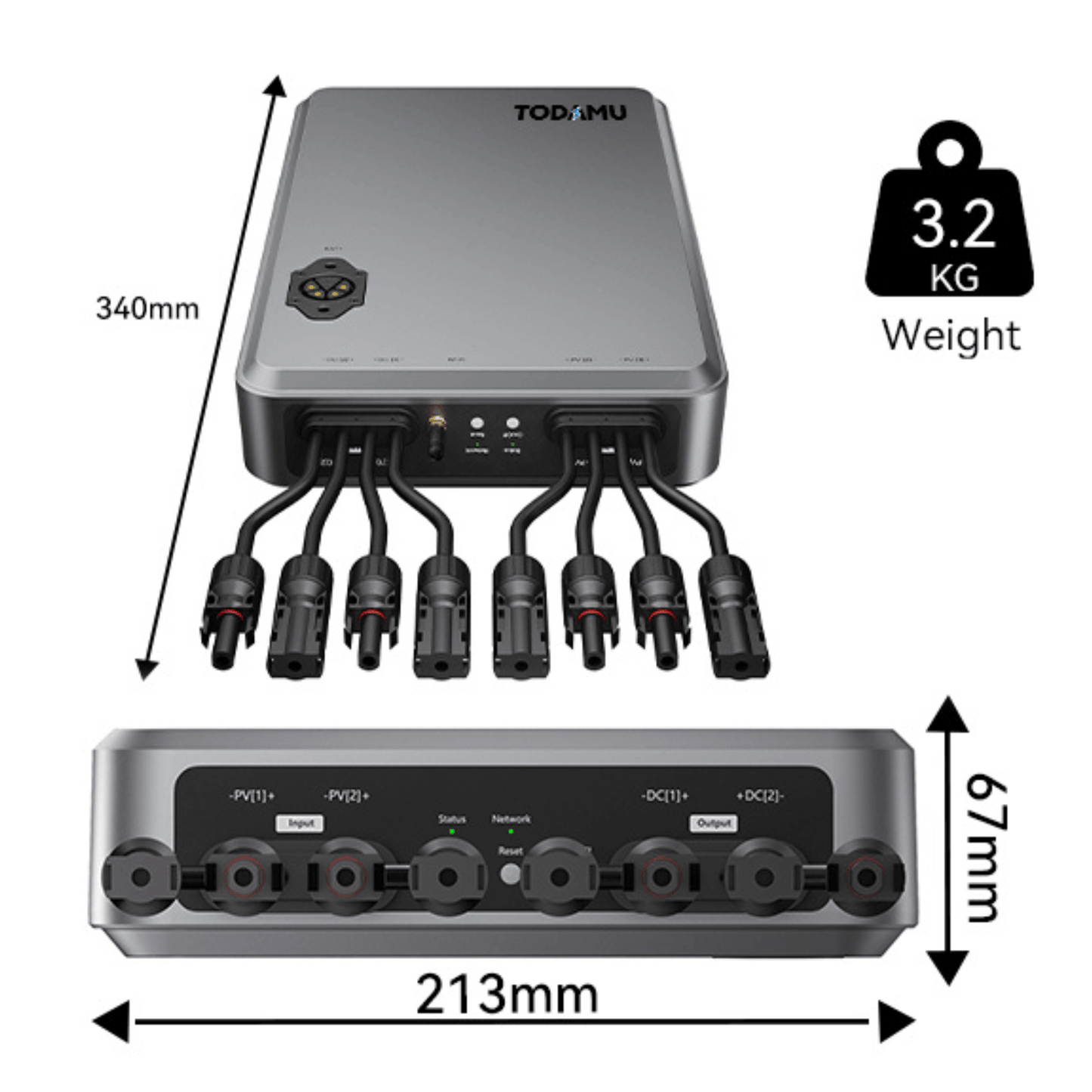
Solar Hub for Balcony Solar Storage and Battery Control
Solar Hub for Balcony Solar Storage and Battery Control
Couldn't load pickup availability
Free shipping costs on all TODAMU Energy orders.
We offer a 30-day no-hassle money-back guarantee.
Multiple items in one order may be shipped separately.
We offer a lifetime of customer service.
The Solar Hub is the part that makes the whole balcony solar storage system easier to manage. It sits between the solar panels, the battery and the microinverter, then helps decide where the energy should go. During the day, it manages solar input and battery charging. When the user needs stored power, it can release energy based on the selected discharge time periods.
Users can check PV input, battery power, charge and discharge power, and the output to the microinverter through the Solar Hub system. The battery itself does not have a separate app; the Solar Hub is the control center for system-level energy management.
This Solar Hub is suitable for balcony solar storage, terrace solar systems, garden solar setups, RV areas, fishing cabins and protected outdoor energy scenes. For snow, boat-side or coastal use, install the Solar Hub in a dry and ventilated location, away from direct seawater spray, submersion and heavy snow coverage.

Central Control for Solar Panels, Battery and Microinverter
The Solar Hub works between the solar panels, battery and microinverter. It manages whether solar energy is stored in the battery, sent toward the microinverter, or released later according to the discharge plan.


Custom Discharge Schedule
Users can set custom discharge time periods according to household routines. For example, the battery can discharge in selected morning, afternoon or evening time windows, helping stored solar power support daily use more precisely.
App-Based System Management
The Solar Hub supports app-based system operation. Users can view PV input power, battery power, charging and discharging power, and Solar Hub output to the microinverter. The app controls the Solar Hub system, not a separate battery app.


Shelly Pro 3EM Smart Meter Compatibility
When used with a compatible Shelly Pro 3EM smart meter, the Solar Hub can help show household energy flow more clearly. This is useful for users who want better visibility of solar generation, battery storage and home power consumption.
Dual MPPT for Solar Input Management
The TE-H1600 Solar Hub supports dual MPPT tracking and 1600W PV input power. It helps manage solar input when panels face different light conditions on balconies, terraces, gardens or compact roofs.

IP65 Protection for Protected Outdoor Areas
The IP65 housing is suitable for balconies, terraces, gardens and protected outdoor installation areas. It should not be submerged in water or directly exposed to seawater spray.


Flexible Energy Control for Boat, RV and Yard Setups
The Solar Hub is designed to manage solar input, battery charging, and scheduled discharge across different outdoor energy scenes, including RV parking areas, yard solar setups, fishing cabins, lakeside sheds, and protected boat-side power use. It helps connect solar panels, battery storage, and the microinverter into one controlled system, so stored solar power can be used later when needed. For boat-side or coastal use, install the Solar Hub in a dry, ventilated, and protected position, away from direct seawater spray, standing water, or submersion.
FAQ About Solar Hub
What role does the Solar Hub play in a balcony solar storage system?
It works as the control center between solar panels, battery storage and the microinverter, helping manage solar input, battery charging, discharge timing and energy flow.
Is the Solar Hub useful for balcony and terrace solar systems?
Yes. It is designed for compact solar storage scenes such as balconies, terraces, gardens and small home energy setups.
Can users set discharge times?
Yes. The Solar Hub supports custom discharge schedules with user-defined time periods.
Does the battery have a separate app?
No. The battery does not have a separate app. Battery operation is managed through the Solar Hub system.
Can the Solar Hub be used in fishing or boat-side scenes?
Yes, it can be used in protected fishing cabin, lakeside or boat-side power setups. Keep the Solar Hub away from direct water spray, seawater and wet surfaces.
Can it be used in cold or snowy areas?
Yes, within the rated operating temperature range. The Solar Hub should be installed in a protected, dry and ventilated location, and should not be covered by snow.
Technical Specifications